

۷ Ways to Make Over Your Smile
Light - Activated Bleaching What it is: In - office whitening treatments, like Zoom! and BriteSmile, use peroxide(the same bleaching agent in drugstore kits). Lip and tongue retractors hold your mouth open, and a wax is painted over your gums, fillings, and any spots the peroxide might irritate. Next, a bleaching gel is applied to the teeth and a blue light activates it for about an hour.
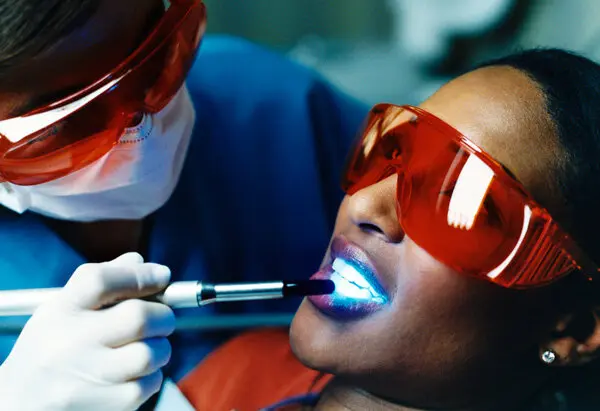
Best for: Those who want instant results and who have sensitive teeth. "Because we cover the areas where the nerves might be exposed, patients are much less likely to experience sensitivity than with other whitening options," says Jeff Golub-Evans, DDS, in New York City, who practices cosmetic dentistry.
Does it work? Yes. It may be slightly uncomfortable to sit in the chair for an hour with your mouth held open, but the procedure can remove about ۱۰ years ' worth of staining, says Golub - Evans. As with all whitening treatments, you can ' t eat or drink anything deeply pigmented, such as berries, soy sauce, red wine, or coffee, for at least ۴۸ hours. " The bleaching agent opens pores in the teeth, which makes them ultra - absorbent to color, " says Pia Lieb, DDS, clinical assistant professor at New York University College of Dentistry. Results last a couple of years if you brush and floss regularly.
Tray Bleaching
What it is: The dentist makes a mold of your teeth to create thin plastic trays that fit like mouth guards. You fill the trays with bleaching gel and wear them for three days, an hour a day, every three months. Steven Fox, DDS, a New York City dentist who has done extensive research in the field of remineralizing teeth, recommends tray bleaching for a few days every two to three months as a good way to maintain the results of an in - office bleaching treatment.
Best for: Maintenance after an in - office whitening treatment.
Does it work? Yes. Because the trays are made specifically to fit your mouth, the peroxide spreads evenly on teeth. But beware of overbleaching: Peroxide can dissolve the calcium in tooth enamel(the outer layer), which exposes the nerves, resulting in sensitivity. Calcium depletion can also cause decay, says Fox. Though teeth can be remineralized with a paste or a fluoride treatment, you shouldn ' t wear the trays more than four to six times per year.
Drugstore Whitening Kits
What they are: Clear strips coated with peroxide gel that you apply to your teeth for five to ۳۰ minutes, depending on the intensity of the peroxide on the strip.
Best for: People with mild staining and plenty of tooth enamel. " Don ' t use these kits if you grind your teeth, have recessed gums, or think you might have a cavity, because the peroxide has a propensity to seep into sensitive areas caused by recession or grinding, " says Michael Apa, DDS, founder of New York University ' s Aesthetics Dental Society.
Do they work? Not as well as in - office bleaching. Drugstore whitening kits simply aren ' t able to achieve the kind of bleaching you can get in the dentist ' s office or with trays, says Robert Reiss, DDS, who has a private practice in New York City. At - home kits will lighten teeth, but you have to be committed and patient; it can take several weeks or more of daily applications to see results, and your teeth may become temporarily sensitive in the process. A common complaint is that the strips are either too narrow and short to fit large teeth, so they don ' t bleach evenly, or they ' re so big that they irritate the gums, says Lieb.
Composite Bonding
What it is: The composite material is reinforced plastic that can repair chips, cracks, and small gaps between the teeth, as well as cover white spots(caused by calcium deposits) that become more apparent as teeth wear down with age. The dentist sculpts the plastic onto the tooth and hardens it with a special light. After it ' s hardened, it ' s sanded and polished so that the surface appears seamless with the natural tooth.
Best for: Small fixes.
Does it work? Yes, and very well. Though the composite material can gradually stain, bonding can be done in one office visit, and it ' s less expensive and invasive than other fixes like veneers. It lasts from five to ۱۵ years, depending on the quality of the dentist ' s work and whether or not you ' re a grinder.