

Videogamers No Better at Talking While Driving
Afkar News: No matter how much time youve spent training your brain to multitask by playing " Call of Duty, " youre probably no better at talking on the phone while driving than anybody else, a new study revealed.
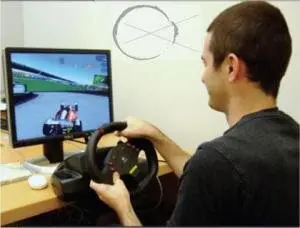
A study by the Visual Cognition Laboratory at Duke University wanted to see whether gamers who have spent hours in front of a screen simultaneously watching the map, scanning doorways for bad guys and listening to the chatter of their fellow gamers could answer questions and drive at the same time. The finding was: not so much, Science Daily reported.
" It doesn ' t matter how much you ' ve trained your brain, we just aren ' t set up to do this, " said Stephen Mitroff, associate professor of psychology and neuroscience and member of the Duke Institute for Brain Sciences.
The lab study measured the performance of ۶۰ undergraduate students on three visual tasks, and then repeated each task while the subject answered Trivial Pursuit questions over a speakerphone. " This was meant to mostly mimic a cell phone conversation, " Mitroff says without a trace of irony.
The tasks were the video driving game " TrackMania, " a standard multiple - object tracking test that is something like a video version of a shell game, and a timed paper - and - pencil administration of hidden pictures puzzles from Highlights Magazine.
The gamers, all men who regularly played first - person shooter games, were significantly better at driving TrackMania with a steering wheel and pedals than the non - gamers, beating them by about ۱۰ seconds on average. The non - gamers, ۱۹ men and seven women, did just as well as the gamers on the multiple moving objects test and the Highlights puzzles.
It was difficult, acknowledges lead author Sarah Donahue who recently completed her Ph. D. at Duke, to find non - gaming men and gaming women on a college campus.
Performance on the driving test was most harmed by talking on the phone, though it also declined on the other two tests. The gamers drove the racetrack about ۲ seconds slower while multitasking, dropping from a mean of ۱۰۱.۷ seconds to ۱۰۳ seconds. The non - gamers were ۱۰ seconds slower, dropping from ۱۱۲.۹ seconds to ۱۲۲.۵.
In multiple - object tracking and the image search puzzle, both gamers and non - gamers saw similar declines in performance while multi - tasking.
So for most people, Mitroff says, multitasking is probably a bad idea. But there is one small exception. A ۲۰۱۰ study by University of Utah psychologists Jason Watson and David Strayer found five people among ۲۰۰ undergraduates who truly could multitask without a loss of performance, whom they dubbed " supertaskers. "
But the other ۹۷.۵ percent of humanity presumably includes the erratic guy you were commuting behind this morning, and you, for that matter.
Source: http://www.sciencedaily.com/releases/2012/06/120613102424.htm