

Anti - Glacier Prayer " Worked Too Well " —Vatican Approves New Ritual
After ۳۵۰ years, and amid a changing climate, Alpine pilgrims warm up to ice.
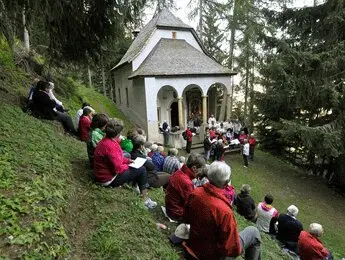
About 50 people set out on foot from the Swiss village of Fiesch at dawn on July 31. As the sun rose over 13,000-foot (4,000-meter) Alpine peaks, the procession moved slowly up a mountainside and into the cool of a pine forest, stopping at a tiny church.
By ۷:۳۰ the group had swollen to around a hundred—too many to fit inside the chapel of Maria Heimsuchung, or Mary of the Visitation, so a makeshift altar was erected outside.
" Glacier is ice, ice is water, water is life, " intoned priest Toni Wenger, before beseeching God to stop the glaciers high above them from melting.
By changing a few, crucial words in the liturgy, Father Wenger reversed a Catholic ritual that for ۳۵۰ years had implored the heavens to push back the glaciers.
The Vatican had approved the change as the effects of global warming became all too tangible in the Alps.
Climate change ' s effects are accentuated in mountainous regions, and in the ۲۰th century temperatures in Alpine Switzerland increased by twice the global average. Today Swiss glaciers are shrinking by nearly ۳۳ feet(۱۰ meters) a year, on average. What ' s more, alpine communities are reporting more rain and stronger winds than in centuries past.
(Read National Geographic magazine ' s " Meltdown: The Alps Under Pressure ")
When Global Cooling Killed
The people of devoutly Catholic Fiesch and Fieschertal have made the annual pilgrimage since ۱۶۷۴, when Europe was in the grip of the Little Ice Age.(Related: " Little Ice Age Shrank Europeans, Sparked Wars. ")
Looming over the villages, the two largest glaciers in the Alps—the Aletsch(satellite picture) and Fiescher(satellite picture) —grew over the next two centuries, reaching their maximum lengths around ۱۸۵۰. Around that time, the Aletsch stretched some ۱۶ miles(۲۶ kilometers); the Fiescher was larger by similar proportions, though exact measurements aren ' t available for the smaller glacier.
The consequences for the villagers were dire.
When pieces of the Aletsch fell into Lake Märjelen—which lies between the two glaciers—the lake overflowed. Three hundred and fifty - three million cubic feet(۱۰ million cubic metres) of water rushed down the valley below, inundating settlements, damaging property, and killing villagers. Extremely poor until the late ۱۹th century, the locals had few options but to rebuild.
Having endured hundreds such diasters, the villagers—with the help of local Jesuits—organized the pilgrimage, to be held annually on July ۳۱: the Catholic feast day dedicated to the Jesuits ' founder, St. Ignatius of Loyola.
Answered Prayers?
The glaciers began receding in the ۱۸۶۰s, and they continue to shrink today.(Watch a glacier recede in a time - lapse video.)
The Aletsch—now ۱۳ miles(۲۱ kilometers) long, about half a mile(۰.۸ kilometer) wide, and roughly ۳,۰۰۰ feet(۹۰۰ meters) deep—has lost nearly ۳ miles(۵ kilometers) in length and ۶۵۰ feet(۲۰۰ meters) in depth since ۱۸۶۴.
" We prayed for the ice to recede, and our prayer worked—too well, " said Herbert Volken, mountain guide and mayor of Conches, the district that includes Fiesch.
In ۲۰۰۹ the local parish council petitioned the Vatican to allow a change in the wording of the prayer. A year later the Holy See agreed, and Volken hopes the new prayer will work as well as the last one.
Today the villagers no longer worry about floods, he said, but about having less drinking water, energy, and food for their animals, and more forest fires. Another problem is the impact the dwindling glaciers could have on tourism—the main source of income, besides hydropower, for the district—which is already strained by recession and the Eurozone crisis.
So far, icemelt doesn ' t appear to be a factor in the tourism dropoff, Volken said. But " if the[Aletsch] glacier isn ' t there any more, the tourists won ' t come. "
(See pictures of the melting Alps.)
Glacial Pace
The effects of global warming are being felt throughout the region.(Video: Melting Alps.)
Not far from Fiesch, the Giesen glacier has developed a gigantic crack and is at risk of collapsing and inundating villages below. In Zermatt—where a shifting glacier defines an international border—the Swiss and Italian governments are in the process of renegotiating their frontier.
The impact of the changing climate will eventually be felt wider still. The Aletsch and Fiescher glaciers—along with many other, smaller ones—feed the Rhône river system, one of Europe ' s most important.
Hanspeter Holzhäuser, a University of Bern geographer who specializes in glacier history, said the Aletsch is losing about ۷۵ feet(۲۳ meters) a year in length.
He ' s tracked the glacier ' s fluctuations over several millennia—using historical records and analyses of ice cores, fossil soils, and wood trapped in the ice—and found clear signs of climate variation.
During the balmy Bronze Age, for example, the Aletsch was between ۲,۰۰۰ and ۳,۰۰۰ feet(۶۱۰ and ۹۱۵ meters) shorter than it is today. But the warmth then, he adds, wasn ' t abetted by human activities.
" Even if all the new prayer does is to draw attention to man - made global warming, " he said, " it ' s a good thing. "
(Related: " Alps Could Be Ice Free by ۲۱۰۰, Study Warns. ")
Whatever the revised prayer ' s effects, they ' re unlikely to be immediate.
Holzhäuser is confident, based on past trends, that the rapid warming—and subsequent melting—will continue for at least the next ۳۰ years. And the consequences may not be entirely obvious.
Earlier this summer, a British couple walking on Aletsch Glacier discovered human remains. The bones, which have been sent to the University of Bern for DNA analysis, are thought to have belonged to local men who disappeared in ۱۹۲۶, probably by falling into a crevasse that then closed above them.
According to Renato Julier, Fiesch ' s head of tourism, other walkers have gone missing in the region since then. " We expect more gruesome discoveries in the future, " Julier said.
If attempts to combat global warming work-or, depending on your beliefs, if God is listening to the people of Fiesch-those missing walkers may remain missing. Arguably, it would be a small price to pay for ensuring the water supply for much of Europe for centuries to come.